
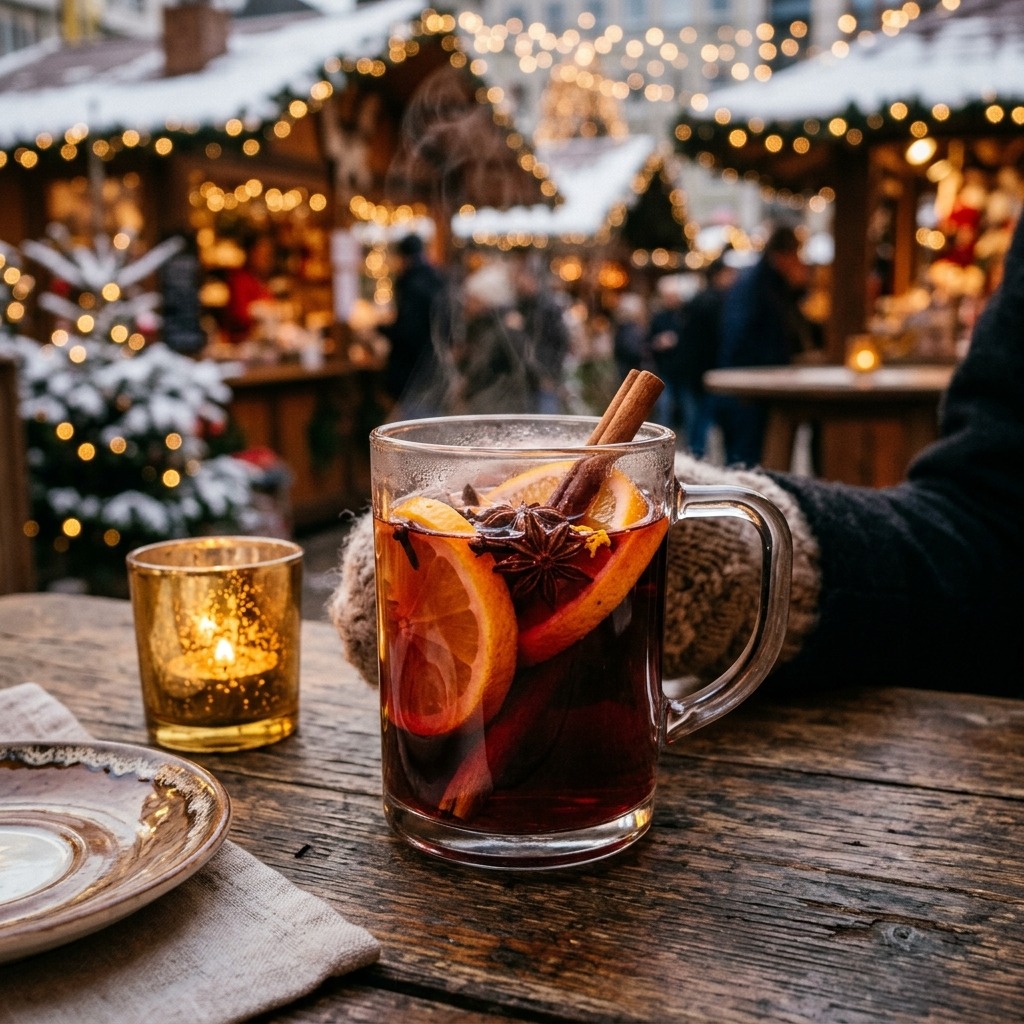
Glühwein is a warm German spiced red wine made by gently simmering dry red wine with cinnamon sticks, cloves, star anise, orange peel, and sugar. Heat the wine below boiling (under 165°F/74°C) for 20–30 minutes, strain, and serve hot. It’s rich, aromatic, and deeply warming ideal for cold-weather gatherings.
Every December, across cobblestone Christmas markets in Germany and Austria, vendors ladle steaming mugs of Glühwein into ceramic cups. Shoppers wrap both hands around the mug, breathe in the cinnamon-spiced steam, and feel the chill melt away. That moment is what this recipe recreates.
Glühwein literally “glow wine” in German is hot spiced wine that has anchored European winter traditions for centuries. Germany alone consumes roughly 40 million liters of Glühwein each year, and its appeal has long since crossed borders into France, the Netherlands, Scandinavia, and beyond.
What Is Glühwein, and Why Is It a Winter Staple?
Glühwein is the German-Austrian version of mulled wine a hot spiced wine drink traditionally associated with Christmas markets (Weihnachtsmarkt). Its name translates directly to “glow wine,” a nod to the warm, rosy feeling it produces on cold winter nights.
Archaeological and historical records trace German mulled wine to at least 1420, when a Glühwein tankard was discovered. Christmas markets have been a fixture in Germany since the 15th century, and Glühwein has been their signature drink ever since. The recipe spread across Europe as each country added its own spin: Sweden’s glogg includes almonds and raisins, France’s vin chaud uses local varieties, and Norway’s gløgg often features cardamom.
What makes Glühwein distinctive compared with other mulled wines is the German focus on simplicity. The spice blend stays restrained and balanced, letting the wine’s fruit character shine through rather than drowning it.
Glühwein Recipe at a Glance
| Detail | Info |
| Prep Time | 5 minutes |
| Cook/Steep Time | 20–30 minutes |
| Total Time | 25–35 minutes |
| Servings | 4–6 |
| Calories (per serving) | ~168–210 kcal |
| Alcohol | Yes (optional to omit) |
| Best Wine Base | Pinot Noir, Merlot, Chianti |
What Ingredients Do You Need for the Best Glühwein Recipe?
A traditional Glühwein recipe uses only a handful of ingredients. Here’s what you’ll need and why each one matters.
Base Ingredients:
- 1 bottle (750 ml) dry red wine Pinot Noir, Merlot, or Chianti. Avoid heavily tannic wines like Cabernet Sauvignon, which can turn bitter when heated. Don’t use your best bottle, but don’t use bad wine either.
- ¾ cup water
- ¼ cup (4 tablespoons) granulated sugar or honey honey adds a floral depth; sugar keeps it cleaner.
- 1 medium orange use both the peel and the juice of half the orange.
- 2 cinnamon sticks
- 4–6 whole cloves start with 4; cloves can overpower quickly.
- 2 whole star anise
Optional Add-Ins:
- 1 cardamom pod (or a pinch of ground cardamom)
- Small piece of fresh ginger
- ¼ vanilla pod
- 1 oz shot of rum, brandy, or cognac per serving this is the “Schuss” (literally “shot”) that Germans traditionally stir in just before drinking.
Spice Guide: What Role Does Each Spice Play in Glühwein?
| Spice | Flavor Profile | Recommended Amount (per bottle) | Boldness Level |
| Cinnamon sticks | Warm, sweet, earthy | 2 sticks | Medium |
| Whole cloves | Sharp, intense, slightly medicinal | 4–6 cloves | High |
| Star anise | Licorice-like, sweet-spiced | 2 pods | Medium-High |
| Cardamom | Floral, citrusy, aromatic | 1 pod | Low-Medium |
| Fresh ginger | Spicy, zesty | 2–3 thin slices | Medium |
| Vanilla pod | Sweet, smooth, creamy | ¼ pod | Low |
| Nutmeg | Nutty, slightly sweet | Pinch only | Low |
How to Make Glühwein: Step-by-Step Easy Recipe
This easy Glühwein recipe takes under 35 minutes and requires just one pot.
Step 1 Prepare the citrus. Using a vegetable peeler, remove wide strips of orange zest, avoiding the white pith (pith turns bitter). Juice half the orange and set both aside.
Step 2 Make a spiced simple syrup. Combine ¾ cup water and ¼ cup sugar in a medium saucepan. Heat over medium until the sugar fully dissolves. Reduce heat to low.
Step 3 Add spices and citrus. Add the orange zest, orange juice, cinnamon sticks, cloves, and star anise. Simmer gently for 1–2 minutes until fragrant.
Step 4 Add the wine. Pour in the full bottle of red wine. Heat slowly this is the critical step. Never let Glühwein boil. Alcohol evaporates at 173°F (78°C), and boiling also strips the delicate fruit aromas and turns the drink bitter. Aim to keep the temperature between 140–165°F (60–74°C).
Step 5 Steep for 20–30 minutes. Let the wine sit at a low simmer, partially covered, for at least 20 minutes. The longer you go (up to 2 hours on the lowest heat), the more the flavors develop.
Step 6 Strain and serve. Pour through a fine-mesh strainer into mugs. Add a Schuss of rum, brandy, or cognac if desired. Garnish with a cinnamon stick and a strip of orange peel.
What Are Common Glühwein Mistakes to Avoid?
Most bad batches of Glühwein come down to a few simple errors:
- Boiling the wine. This is the #1 mistake. Keep the temperature below 165°F (74°C) at all times.
- Using too many cloves. Four to six is enough for one bottle. More than that, and cloves dominate everything.
- Using over-oaked or heavily tannic wine. These wines turn harsh with heat. Stick to medium-bodied, fruit-forward reds.
- Not steeping long enough. A minimum of 20 minutes is needed for the spices to fully infuse.
- Sweetening too aggressively. Start with ¼ cup sugar and taste before adding more.
What Are the Different Types of Glühwein?
Glühwein has several well-loved variations depending on taste preferences and occasion.
White Glühwein (Weißer Glühwein)
Swap the red wine for a dry white, such as Riesling or Pinot Grigio. This version is lighter, more citrus-forward, and slightly less rich. It pairs well with fish, cheese, and lighter appetizers.
Non-Alcoholic Glühwein (Kinderpunsch)
Germany’s beloved Kinderpunsch (“children’s punch”) uses the same spice blend but replaces wine with a mix of apple juice, grape juice, cranberry juice, and herbal tea. It’s a festive option for kids, non-drinkers, and designated drivers.
Kinderpunsch base ratio (per 750ml):
- 2 cups apple juice
- 1 cup cranberry or grape juice
- ½ cup strong black tea or rooibos
Cherry or Blueberry Glühwein
A specialty at Germany’s Nuremberg Christmas Market, this version uses cherry or blueberry wine or adds a splash of blueberry juice to standard red wine. Skip or reduce the added sugar, as fruit wines tend to be sweeter.
Glühwein mit Schuss (The Boosted Version)
The classic adult upgrade: stir a 1 oz shot of rum, cognac, or amaretto into your finished mug just before serving. Amaretto adds an almond-sweet note that pairs particularly well with the star anise.
Regional Variations Across Europe
| Country | Local Name | Key Differences |
| Germany / Austria | Glühwein | Classic red wine base; minimal spices |
| Sweden | Glogg | Adds blanched almonds and raisins |
| France | Vin Chaud | Often uses local Bordeaux; less sweet |
| Netherlands | Glühwein / Warme Wijn | Similar to German version |
| UK | Mulled Wine | Heavier on nutmeg and allspice |
| Czech Republic | Svařák | Often includes star anise and orange |
What Foods Pair Best with Glühwein?
Glühwein’s warm spiced profile pairs best with rich, savory, or sweet winter foods.
| Food | Why It Works |
| Gingerbread (Lebkuchen) | Mirrors the warm spice notes |
| Stollen (German fruit bread) | Complementary sweetness and dried fruit |
| Roasted chestnuts | Earthy, nutty contrast to the wine’s fruit |
| Spiced sausages / Bratwurst | Savory fat balances the wine’s sweetness |
| Aged cheeses (Gruyère, Gouda) | Salt and richness cut through the spice |
| Dark chocolate | Amplifies the red wine’s fruit notes |
| Cinnamon pastries | Reinforces cinnamon spice harmony |
How Should You Store and Reheat Glühwein?
Storage: Let cooled Glühwein come to room temperature, then transfer it (unstrained or strained) to an airtight container. Refrigerate for up to 3 days. The spices will continue to infuse while it sits, so the second-day batch is often even better.
Reheating: Warm gently in a saucepan over low heat. Never microwave in large batches uneven heating causes partial boiling. Aim again for 140–165°F (60–74°C).
Batch prep: Glühwein scales easily. For a crowd of 20, use 4–5 bottles and multiply all ingredients accordingly. A slow cooker set to the “warm” or “low” setting is ideal for keeping large batches ready to serve for hours.
The Right Way to Present and Serve Glühwein
Traditional German Christmas market mugs are ceramic, squat, and heat-retaining they’re designed to keep the drink warm in freezing temperatures. At home, use thick ceramic mugs or heatproof glass mugs. Avoid thin wine glasses, which lose heat quickly.
Serving temperature: 140–160°F (60–70°C) is the sweet spot. Too hot, and it’s uncomfortable to drink. Too cool, and the aroma fades.
Garnish with intention: A cinnamon stick, a twist of orange peel, or a star anise on the surface tells the drinker exactly what to expect flavor-wise. It also makes a simple drink look impressive.
Frequently Asked Questions About Glühwein
How old is the Glühwein tradition?
Glühwein has been documented in Germany since at least 1420, based on the discovery of a Glühwein tankard from that era. German Christmas markets, where Glühwein is the centerpiece drink, have been held since the 15th century.
Why can’t you boil Glühwein?
Alcohol begins to evaporate at 173°F (78°C). Boiling also breaks down the wine’s delicate fruit aromas and extracts bitter compounds from the spices. Keep your Glühwein below 165°F (74°C) throughout.
How much Glühwein does one bottle of wine make?
One standard 750ml bottle yields approximately 4–6 servings, depending on mug size. Traditional German Christmas market mugs hold roughly 200ml (about 6.7 oz).
Can I make Glühwein ahead of time?
Yes. Glühwein can be made up to 3 days ahead and refrigerated. Reheat gently over low heat. The spices continue to infuse during storage, so flavors deepen over time.
What is the best wine for Glühwein?
Medium-bodied, fruit-forward, low-tannin red wines work best. Pinot Noir (German Spätburgunder is a traditional choice), Merlot, and Chianti are all reliable options. Avoid heavily oaked Cabernet Sauvignon, which turns astringent when heated.
What does “Schuss” mean in Glühwein?
“Schuss” means “shot” in German. Glühwein mit Schuss refers to a serving with a shot of rum, brandy, cognac, or amaretto stirred in just before drinking. It’s a popular customization at German Christmas markets.
Is Glühwein the same as mulled wine?
Glühwein is a specific German and Austrian style of mulled wine. While all Glühwein is mulled wine, not all mulled wine is Glühwein. The German version traditionally uses fewer spices and keeps sweetness minimal compared to British mulled wine, which often includes allspice, nutmeg, and more sugar.
How many calories are in Glühwein?
A standard serving (approximately 150ml/5oz) contains roughly 168–210 calories, depending on the amount of sugar added and whether a shot of liquor is included.
Can you make Glühwein without alcohol?
Yes. The German non-alcoholic equivalent is called Kinderpunsch (children’s punch). Replace wine with a blend of apple juice, cranberry or grape juice, and strong black or rooibos tea, using the same spices. It tastes festive and warming without the alcohol content.
How long can Glühwein stay warm in a slow cooker?
A slow cooker set to “warm” (typically 145–165°F/63–74°C) can hold Glühwein safely for 4–6 hours without degrading flavor. This makes it the preferred method for serving at parties. Stir occasionally and taste every hour, adding a splash of fresh wine if the flavor becomes too concentrated.
Gluhwein Drink Recipe: How to Make Authentic German Mulled Wine
Ingredients
Instructions
-
add suger
How to Make Glühwein: Step-by-Step Easy Recipe -
add ice
This easy Glühwein recipe takes under 35 minutes and requires just one pot. -
mix ingredients
Step 1 Prepare the citrus. Using a vegetable peeler, remove wide strips of orange zest, avoiding the white pith (pith turns bitter). Juice half the orange and set both aside. -
shake
Step 2 Make a spiced simple syrup. Combine ¾ cup water and ¼ cup sugar in a medium saucepan. Heat over medium until the sugar fully dissolves. Reduce heat to low. -
stir gently
Step 3 Add spices and citrus. Add the orange zest, orange juice, cinnamon sticks, cloves, and star anise. Simmer gently for 1–2 minutes until fragrant. -
Garnish
Step 4 Add the wine. Pour in the full bottle of red wine. Heat slowly this is the critical step. Never let Glühwein boil. Alcohol evaporates at 173°F (78°C), and boiling also strips the delicate fruit aromas and turns the drink bitter. Aim to keep the temperature between 140–165°F (60–74°C). -
serve and enjoy
Step 5 Steep for 20–30 minutes. Let the wine sit at a low simmer, partially covered, for at least 20 minutes. The longer you go (up to 2 hours on the lowest heat), the more the flavors develop. -
strain
Step 6 Strain and serve. Pour through a fine-mesh strainer into mugs. Add a Schuss of rum, brandy, or cognac if desired. Garnish with a cinnamon stick and a strip of orange peel.